
Views: 0 Author: Site Editor Publish Time: 2026-06-24 Origin: Site


Digital Out-of-Home media is rapidly evolving beyond flat, two-dimensional panels. Brands now captivate audiences using multi-sided, spatial installations. This transition redefines how public spaces communicate visual stories. Viewers no longer just walk past static images. Instead, they stop, interact, and immerse themselves in dynamic spatial environments.
An LED Cube Screen shifts commercial messaging from passive viewing to active, experiential engagement. They create a physical presence capturing attention from multiple directions simultaneously. Successfully deploying an Advertising LED cube requires more than just purchasing hardware. It demands a strategic alignment of structural engineering, specialized anamorphic content, and rigorous hardware evaluation.
You will learn how to navigate these technical requirements effectively. We explore the mechanics of forced perspective, vital hardware specifications, and installation realities. Understanding these elements ensures verifiable campaign success and robust audience engagement.
Visual ROI: Multi-sided spatial displays command higher viewer dwell times and generate significant user-generated content (UGC) virality compared to standard flat advertising LED panels.
The Seamless Imperative: The illusion of 3D depth relies entirely on specialized 90-degree seamless corner modules and high-refresh-rate synchronization.
Content Dependency: Budgeting must account for custom anamorphic 3D video production; standard 2D video assets will not yield the "glasses-free 3D" effect on a cube.
Deployment Risks: Key implementation hurdles include structural weight load limits, internal heat dissipation, and front-serviceability requirements.
Malls, transit hubs, and flagship retail stores face high levels of visual clutter. Consumers easily ignore standard flat screens. Spatial disruption changes this dynamic entirely. A multi-sided display demands attention through its sheer physical volume. It introduces striking depth and movement into pedestrian traffic zones. Viewers naturally pause to process three-dimensional illusions. This increased dwell time directly boosts brand recall and message retention.
Consumers frequently record glasses-free 3D illusions on their smartphones. They share these captivating videos across social media platforms instantly. This user-generated content acts as a powerful campaign multiplier. Your visual messaging reaches millions online at zero additional distribution cost. Virality transforms a localized physical installation into a global digital campaign.
Media buyers recognize this increased engagement value. Retail property owners subsequently charge premium rates for anamorphic 3D ad slots. The unique format justifies higher media spend compared to traditional flat-screen placements. Brands eagerly pay for inventory delivering guaranteed stopping power. This creates a highly profitable revenue stream for property managers.
Deployment applications vary widely based on architectural limits and creative goals. We can categorize them into three distinct models:
Ceiling-hung centerpieces: These dominate open atriums, providing maximum visibility across multiple floors.
Pillar-wrapped cubes: These turn structural load-bearing columns into premium digital assets.
Floor-mounted interactive installations: These invite direct pedestrian engagement at eye level.
Anamorphic illusions rely on the mathematical manipulation of forced perspective. Content creators deliberately distort images across multiple 90-degree planes. The brain interprets these distorted visuals as having true physical depth when viewed from a specific angle. Characters or objects appear to break out of the screen's boundaries. Viewers experience profound depth without needing specialized 3D glasses.
You must understand the concept of the optimal "sweet spot." The perfect 3D pop-out effect requires a specific viewing point. If viewers stand outside this zone, the image appears slightly stretched. However, secondary angles still provide a high-quality, multi-planar viewing experience. Transparent site planning ensures the highest foot traffic aligns directly with this optimal viewing angle.
Software synchronization handles the seamless merging of these visual planes. Zero-latency receiving cards are absolutely essential. Frames crossing the cube's corners must align perfectly without tearing. Even a one-millisecond processing delay causes a visible break in the moving image. This subtle tearing instantly destroys the carefully crafted 3D illusion.
Best Practice: Always test digital content templates on-site before final rendering. Mark the intended sweet spot on the floor. Verify the illusion holds strong during peak ambient light conditions.
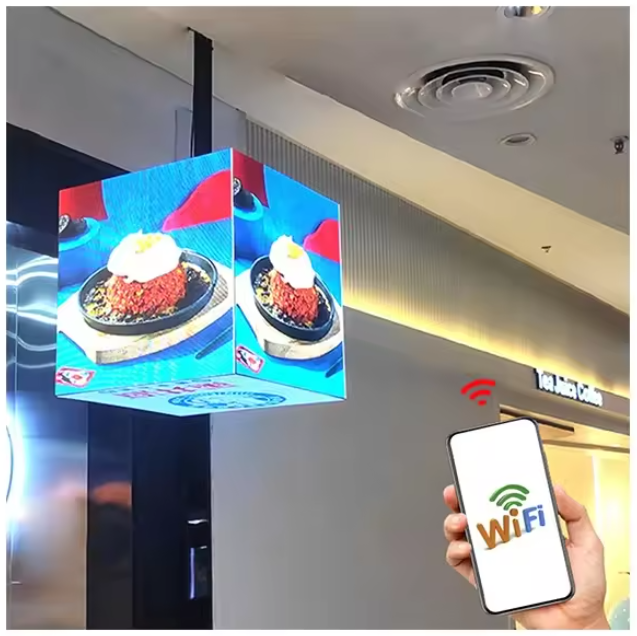
Standard cabinet splicing completely fails for spatial installations. Traditional splicing leaves visible black structural lines at the connecting edges. These lines act as visual barriers, instantly breaking the continuous 3D illusion. You need custom beveled modules or specialized curved corner tiles. They ensure a perfectly continuous pixel transition across every intersecting plane.
Mapping viewing distance to pixel pitch dictates your final resolution. Selecting the wrong pitch wastes budget or ruins clarity. Indoor environments typically demand P1.8 to P2.5 options. This tight pixel density ensures close-proximity clarity for pedestrian traffic. Outdoor environments require P3 to P5 options. This range provides a durable balance of resolution and weatherproofing for longer viewing distances.
Brightness and contrast metrics directly influence perceived depth. High-contrast black SMD LEDs play a massive role here. They deepen shadow details, which significantly enhances 3D depth perception. Standard indoor thresholds range from 800 to 1,200 nits. Outdoor installations require robust outputs exceeding 5,000 nits to combat direct sunlight glare.
Consumer smartphones act as your secondary distribution channel. Therefore, demand a minimum 3840Hz refresh rate. A high refresh rate ensures the screen appears completely flicker-free when photographed or filmed. Lower refresh rates produce ugly black scan lines on camera sensors. This ruins the user-generated content potential of your installation.
Environment | Recommended Pixel Pitch | Brightness Target | Refresh Rate |
|---|---|---|---|
Indoor Retail/Atrium | P1.8 - P2.5 | 800 - 1,200 nits | ≥ 3840Hz |
Outdoor Plaza/Transit | P3.0 - P5.0 | 5,000+ nits | ≥ 3840Hz |
Procuring premium hardware only solves half the equation. The physical screen alone does not magically generate spatial visuals. It requires pre-rendered, mathematically mapped anamorphic video files. Standard 2D advertising files simply will not work. Playing standard content results in disjointed imagery separated across multiple distinct faces.
Procurement teams often overlook the intensive content creation phase. You must allocate a significant portion of your initial budget to specialized 3D motion graphic studios. Creating spatial content requires complex software mapping and extensive rendering time. High-quality visual assets dictate the success of the entire hardware investment.
Playback hardware faces immense processing demands. Media servers must decode massive, high-bitrate multi-canvas video files simultaneously. Evaluate decoding capabilities carefully. Frame drops severely disrupt the spatial experience. Ensure your chosen server handles the exact pixel mapping resolution of your specific physical layout without performance throttling.
Common Mistake: Treating a cube like a standard 16:9 monitor. Always build a custom pixel map template for your motion designers before they begin drafting storyboards.
Four-to-five-sided ceiling-mounted displays introduce massive weight constraints. Calculating suspension rigging requirements demands rigorous engineering audits. Standard iron cabinets often exceed safe load-bearing limits. Lightweight die-cast aluminum chassis options reduce structural load significantly. Always consult licensed structural engineers before finalizing mounting points above pedestrian zones.
Thermal management presents a unique physical challenge. A closed-loop hardware design traps heat internally. Diodes and power supplies generate significant thermal output during continuous operation. You must evaluate active internal cooling systems against passive heat dissipation designs. Poor thermal management leads directly to premature diode failure and color degradation.
Maintenance access requires specialized mechanical solutions. Rear access remains physically impossible in a sealed, multi-sided structure. You absolutely need fully front-accessible magnetic modules. This critical design allows technicians to swap faulty parts from the outside effortlessly. Technicians use suction tools to remove individual pixel modules safely.
Safety certifications protect public spaces and mitigate liability. Ensure the chosen system complies with regional safety standards. Look for verifiable CE, FCC, and RoHS marks. Fire-retardant structural requirements are also mandatory for indoor public environments. Strict adherence to these compliance standards prevents costly regulatory shutdowns.
Deploying spatial digital displays demands precision planning and strategic execution. Hardware specifications, structural limits, and specialized content creation must operate in perfect harmony. Follow these actionable next steps to secure campaign success:
Prioritize specialized seamless corner modules and robust media decoding servers during procurement.
Balance pixel pitch strictly against the primary pedestrian viewing distances of your location.
Secure an experienced 3D motion graphics partner long before hardware installation begins.
Request physical prototype mock-ups to review corner-gap tolerances and brightness levels.
Conduct thorough structural engineering audits to verify load limits and safe rigging points for your intended site.
A: Yes, the screen functions as a standard display, but standard 2D video will simply look like four separate flat screens playing simultaneously, forfeiting the 3D depth effect.
A: While the weight per square meter is similar (typically 25-35kg/sqm for die-cast aluminum), the multi-sided nature exponentially increases total structural weight, requiring robust ceiling trussing or floor reinforcement.
A: Industry standard is roughly 100,000 hours of continuous operation, though half-life brightness degradation and power supply replacements should be factored into a long-term maintenance model.